



To view this video, please enable marketing cookies from Cookie Preferences in the footer.

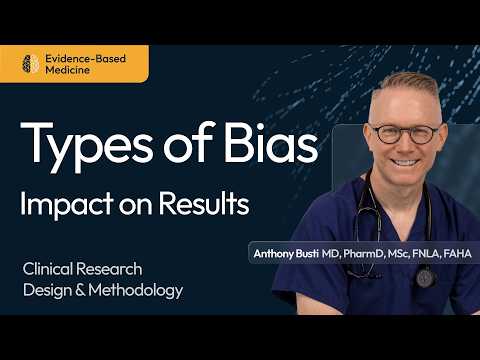
Types of bias in research and their impact on results are critical to understanding study design, internal validity, and clinical decision-making. In this lecture on This Is Why, Dr. Busti walks through how bias is introduced, how it affects results, and how clinicians should interpret it.
This lecture is part of the This Is Why evidence-based medicine (EBM) series, designed to help clinicians connect research methodology to real-world practice.
Topics Covered:
- Equation of error: truth, bias, and random error
- Internal validity and critical appraisal
- Selection bias and sampling bias
- Confounding and lead-time bias
- Recall bias and observer bias
- Loss to follow-up and procedure bias
- Differential vs non-differential misclassification
- Study design hierarchy and risk of bias
- Publication bias and clinical trial registries
- Why bias control changes effect size
Table of Contents
00:00 - Introduction to Bias in Clinical Research
02:40 - Importance of Study Design & Research Quality
05:06 - Random Error vs Systematic Bias
07:28 - Selection Bias Explained
10:25 - Confounding Bias & Hidden Variables
12:05 - Recall & Observer Bias
16:30 - Publication Bias & Research Transparency
23:00 - Conclusions
If this helped you, please like, subscribe, and share it with a classmate or colleague. That will help this new channel continue producing free, high-yield medical education content.
Don’t forget to turn on notifications so you don’t miss upcoming lectures in pharmacology, medical rounds, and more!
#bias in research #study design #internal validity #evidence based medicine #Dr Busti
Speaker:
Anthony Busti, MD, PharmD, MSc, FAHA, FNLA, is a licensed healthcare professional and medical educator with over 30 years of experience in clinical practice and academic teaching. He has trained and practiced as a nurse, pharmacist, and physician, bringing a uniquely comprehensive perspective to patient care and medical education.
Dr. Busti is dedicated to advancing evidence-based medicine and helping clinicians understand the underlying “why” behind clinical decisions to improve patient outcomes.
About This Channel:
This content is created by Anthony Busti, MD, PharmD, MSc, FAHA, FNLA, a board-certified physician with training at Johns Hopkins School of Medicine and University of Oxford and a medical educator for healthcare professionals and students. All material is based on current medical literature and evidence-based guidelines that align with principles of evidence-based medicine (EBM) and Evidence-Based Healthcare (EBHC).
Disclaimer:
This content is for educational purposes only and is not medical advice. It does not replace individualized evaluation, diagnosis, or treatment. Always seek the advice of a qualified health provider with questions about a medical condition and never delay care because of educational content.
More than just access—it’s where understanding deepens.
Create a free account or log in to gain access to this content!
Dive Deeper
Bonus Video (ad free)

To view this video, please enable marketing cookies.
Downloads
Dive Deeper
Bonus Video
Downloads
Related Topics