



To view this video, please enable marketing cookies from Cookie Preferences in the footer.
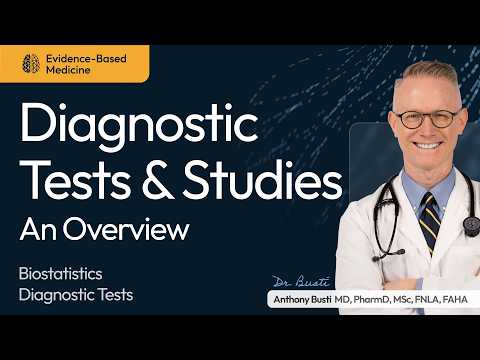
Diagnostic studies are foundational to evidence-based medicine because they help clinicians determine disease presence, severity, progression, and treatment response. In this episode of This Is Why with Dr. Busti, Dr. Busti explains the essential framework behind diagnostic studies, including sensitivity, specificity, predictive values, likelihood ratios, and critical appraisal tools used to evaluate study validity.
This Is Why understanding diagnostic studies matters for every clinician. Dr. Busti breaks down how diagnostic assays are developed, validated, and interpreted using practical clinical examples including troponins, HIV viral load monitoring, BNP in heart failure, and lactate clearance in sepsis.
You’ll also learn how evidence-based medicine frameworks differ for diagnostic research, including PER, PIRT, and PIRO formats, along with the importance of gold standard reference tests, observer agreement, bias reduction, and diagnostic study reporting standards.
Topics Covered:
- Diagnostic studies in clinical medicine
- Sensitivity vs specificity explained
- Positive and negative predictive values
- Pre-test and post-test probability
- Likelihood ratios and diagnostic accuracy
- Gold standard reference testing
- Evidence-based medicine diagnostic frameworks
- Bias and validity in diagnostic studies
- QUADAS-2 critical appraisal overview
- Applying diagnostic evidence clinically
Chapter Table of Contents
0:00 Introduction to Diagnostic Test Interpretation
1:30 Speed Bump Test Example for Appendicitis
2:00 Diagnostic Tests in the Biostatistics Framework
4:09 Key Metrics: Sensitivity, Specificity, ROC, AUC
5:04 Why Diagnostic Study Design Matters
7:11 Clinical Uses of Diagnostic Tests
9:49 Gold Standards, Reference Standards, and 2×2 Tables
12:46 No Diagnostic Test Is Perfect
14:10 Researcher vs Clinician View of Test Performance
16:40 Pretest Probability, Likelihood Ratios, and Post-Test Probability
19:30 Flu Testing Example: False Positives and False Negatives
22:35 Testing Thresholds vs Treatment Thresholds
24:36 How to Read a Diagnostic Study
27:42 Validity, Bias, QUADAS, and STARD Reporting Guidelines
👉 High-Yield EBM Practice Questions: https://www.highyieldmedreviews.com/ebm-biostatistics-literature-evaluation-online-review-course
If this helped you, please like, subscribe to our YouTube Channel, and share it with a classmate or colleague. That will help this new channel continue producing free, high-yield medical education content.
Don’t forget to turn on notifications on YouTube so you don’t miss upcoming lectures in pharmacology, medical rounds, and more!
#DiagnosticStudies #SensitivityAndSpecificity #EvidenceBasedMedicine #ClinicalReasoning #MedicalDiagnostics #DrBusti
Speaker:
Anthony Busti, MD, PharmD, MSc, FAHA, FNLA, is a licensed healthcare professional and medical educator with over 30 years of experience in clinical practice and academic teaching. He has trained and practiced as a nurse, pharmacist, and physician, bringing a uniquely comprehensive perspective to patient care and medical education.
Dr. Busti is dedicated to advancing evidence-based medicine and helping clinicians understand the underlying “why” behind clinical decisions to improve patient outcomes.
About This Channel:
This content is created by Anthony Busti, MD, PharmD, MSc, FAHA, FNLA, a board-certified physician with training at Johns Hopkins School of Medicine and University of Oxford and a medical educator for healthcare professionals and students. All material is based on current medical literature and evidence-based guidelines that align with principles of evidence-based medicine (EBM) and Evidence-Based Healthcare (EBHC).
Disclaimer:
This content is for educational purposes only and is not medical advice. It does not replace individualized evaluation, diagnosis, or treatment. Always seek the advice of a qualified health provider with questions about a medical condition and never delay care because of educational content.
More than just access—it’s where understanding deepens.
Create a free account or log in to gain access to this content!


Related Topics