



To view this video, please enable marketing cookies from Cookie Preferences in the footer.

In this episode of This Is Why, Dr. Busti explores a universal experience for every clinician in the day of Evidence-Based Medicine (EBM) or Evidence-Based Clinical Practice (EBP) — that uncomfortable moment when you realize you don’t know something you feel you should. Known as cognitive dissonance, this moment can either hinder or drive professional growth, depending on how we respond.
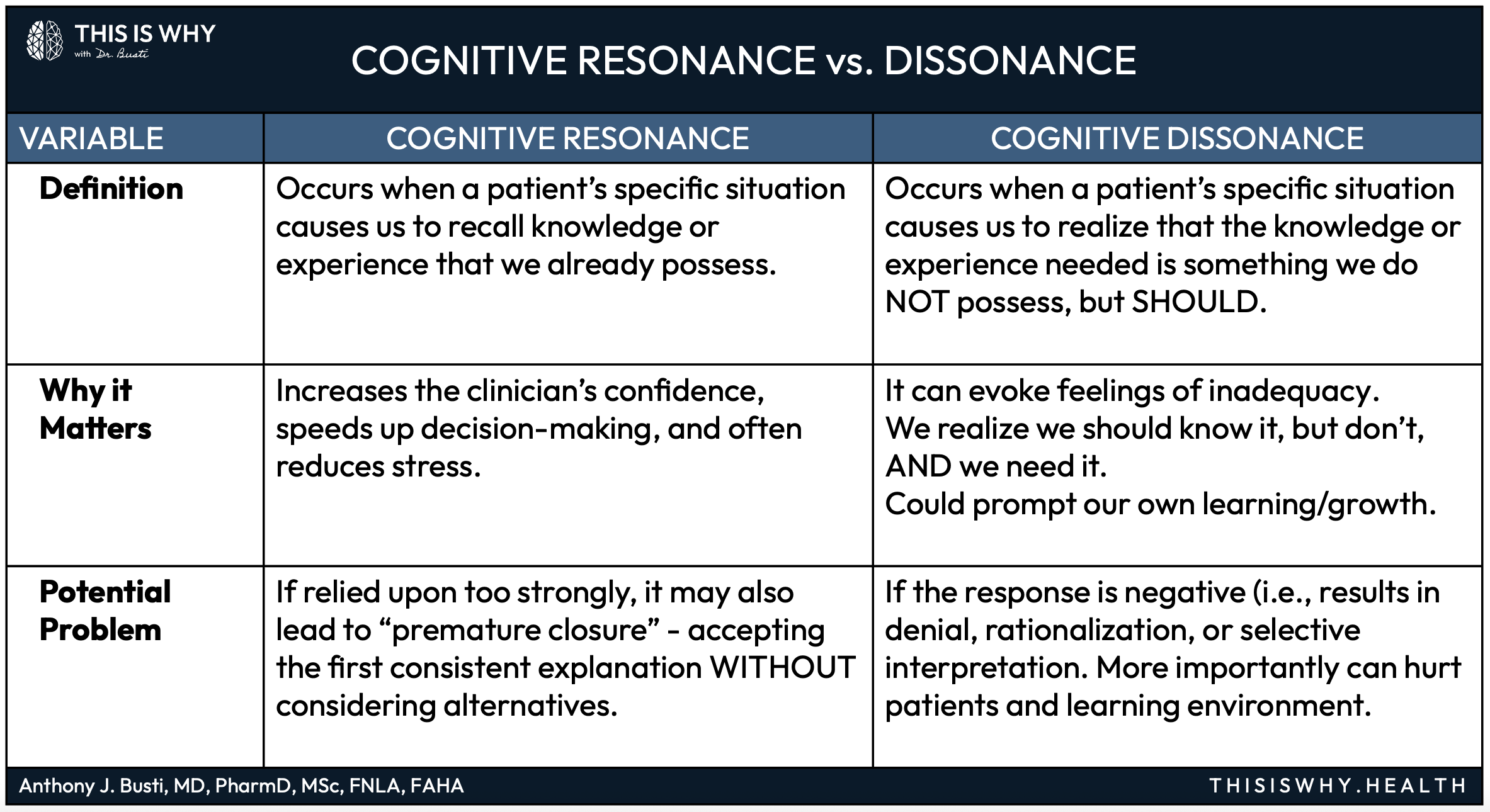
Through the lens of Evidence-Based Medicine (EBM), Dr. Busti explains how to recognize the difference between cognitive resonance (knowledge in alignment) and cognitive dissonance (knowledge gap awareness), and how each impacts learning, humility, and patient care.
Learn how balanced self-reflection, humility, and modeling evidence-based thinking can transform those “I don’t know” moments into powerful opportunities for growth and better clinical decision-making.
Chapters
00:00 – Welcome to This Is Why
00:44 – When we realize we don’t know something
00:59 – Healthy vs. unhealthy responses to dissonance
01:28 – Quick EBM refresher: balancing evidence, expertise, and patient factors
03:58 – Cognitive resonance vs. dissonance explained in EBM
06:23 – How humility supports lifelong learning
14:10 – The expert’s dilemma: pressure to always know
16:31 – Modeling EBM for the next generation
17:37 – Closing thoughts: turning “I don’t know” into transformation
Speaker:
Anthony Busti, MD, PharmD, MSc, FAHA, FNLA, is a licensed healthcare professional and medical educator with over 30 years of experience in clinical practice and academic teaching. He has trained and practiced as a nurse, pharmacist, and physician, bringing a uniquely comprehensive perspective to patient care and medical education.
Dr. Busti is dedicated to advancing evidence-based medicine and helping clinicians understand the underlying “why” behind clinical decisions to improve patient outcomes.
About This Channel:
This content is created by Anthony Busti, MD, PharmD, MSc, FAHA, FNLA, a board-certified physician with training at Johns Hopkins School of Medicine and University of Oxford and a medical educator for healthcare professionals and students. All material is based on current medical literature and evidence-based guidelines that align with principles of evidence-based medicine (EBM) and Evidence-Based Healthcare (EBHC).
Disclaimer:
This content is for educational purposes only and is not medical advice. It does not replace individualized evaluation, diagnosis, or treatment. Always seek the advice of a qualified health provider with questions about a medical condition and never delay care because of educational content.
More than just access—it’s where understanding deepens.
Create a free account or log in to gain access to this content!
Related Topics