



To view this video, please enable marketing cookies from Cookie Preferences in the footer.

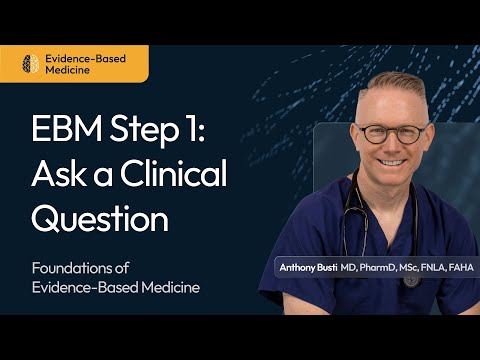
In this episode of This Is Why, Dr. Busti breaks down Step 1 of the 5 As of Evidence-Based Medicine (EBM): "Ask"— how to formulate an answerable clinical question that drives better patient outcomes in evidence based clinical practice. Dr. Busti makes this first step easy and clinically relevant in this evidence-based medicine course - EBM made easy!
Learn:
- The difference between background and foreground questions
- How to structure them using PICO & PICOTS
- Understand why asking the right question is the foundation of every evidence-based decision.
Dr. Busti walks through real clinical examples, including asthma, hypertension, and acute MI, to demonstrate how thoughtful question design leads to more efficient searching, stronger evidence, and smarter patient care.
Get more with a free membership at https://www.thisiswhy.health/
- Access free downloads from our videos
- Organize content via playlists & collections
- Join live Q&A
- Receive member newsletters
- Unlock partner coupons & discounts
Chapters
00:00 – Welcome & overview of Evidence-Based Medicine (EBM)
00:33 – The five A’s of EBM explained
01:23 – Step 1: Ask a Clinical Question – Why the question matters
02:54 – Background vs. Foreground questions
07:42 – Expanding to PICOTS (Timing & Setting)
13:55 – Using PICO to build structured EBM questions
16:05 – Clinical examples: Asthma, Hypertension, and STEMI
20:46 – From asking to acquiring – building search-ready questions to get the best evidence
26:58 – Key takeaways and next step in EBM
#evidencebasedmedicine #ebm #evidencebasedpractice #evidencebasedmedicinecourse #5AsofEBM
Speaker:
Anthony Busti, MD, PharmD, MSc, FAHA, FNLA, is a licensed healthcare professional and medical educator with over 30 years of experience in clinical practice and academic teaching. He has trained and practiced as a nurse, pharmacist, and physician, bringing a uniquely comprehensive perspective to patient care and medical education.
Dr. Busti is dedicated to advancing evidence-based medicine and helping clinicians understand the underlying “why” behind clinical decisions to improve patient outcomes.
About This Channel:
This content is created by Anthony Busti, MD, PharmD, MSc, FAHA, FNLA, a board-certified physician with training at Johns Hopkins School of Medicine and University of Oxford and a medical educator for healthcare professionals and students. All material is based on current medical literature and evidence-based guidelines that align with principles of evidence-based medicine (EBM) and Evidence-Based Healthcare (EBHC).
Disclaimer:
This content is for educational purposes only and is not medical advice. It does not replace individualized evaluation, diagnosis, or treatment. Always seek the advice of a qualified health provider with questions about a medical condition and never delay care because of educational content.
More than just access—it’s where understanding deepens.
Create a free account or log in to gain access to this content!


Related Topics