




The Clue You Cannot Miss: How Clinicians Learn to Recognize Red Flags
Some clinical cases look obvious at first.
A patient has a sore throat, fever, swollen lymph nodes, and tonsillar exudates. The diagnosis seems straightforward: strep throat. Start an antibiotic and move on.
But then one detail changes everything.
The swollen lymph nodes are not in the front of the neck. They are in the back. The patient also has left upper quadrant abdominal pain. A few days after starting amoxicillin, they develop a diffuse rash.
Now the case looks very different. This may not be strep pharyngitis at all. It may be infectious mononucleosis. And the rash may not mean the patient has a true penicillin allergy.
That is the power of a red flag.

In medicine, the difference between a good decision and a dangerous one often comes down to one detail that should make you pause. Not because the detail is obscure. Not because it is a trick. But because it points to a pattern you cannot afford to miss.
That is true on exams. But more importantly, it is true at the bedside.
Clinical reasoning is not just about knowing facts. It is about knowing which facts matter.
Red Flags Are Not Random Facts
A red flag is a detail that should immediately raise your level of attention. It may be a medication buried in the patient’s list. It may be a lab value that does not fit the presumed diagnosis. It may be a symptom that seems minor until you realize it changes the entire case.
This is why certain medications show up again and again in clinical teaching, board exams, and real-world patient care. Educators are not obsessed with these drugs because they are random trivia. They show up because they carry predictable risks that clinicians need to recognize.
If you see amiodarone in a medication list, you should not just think, “antiarrhythmic.” You should think about its long half-life, drug interactions, pulmonary toxicity, thyroid effects, liver toxicity, and QT prolongation. If you see digoxin, you should think about renal function, potassium, narrow therapeutic index, drug interactions, and toxicity. If you see warfarin, you should immediately ask what else the patient is taking, because drugs like metronidazole, trimethoprim-sulfamethoxazole, fluconazole, and amiodarone can turn a stable anticoagulation plan into a bleeding problem.
The same is true with lithium. If a patient taking lithium presents with confusion, tremor, ataxia, slurred speech, or neurologic decline, that medication list is not background noise. It may be the diagnosis.
These are not just “exam facts.” They are clinical warning lights.
The point is not to memorize a list and move on. The point is to train your brain to say, “Wait. That detail matters.”
That pause is often where better clinical reasoning begins.
The Danger of Anchoring Too Early
Clinicians have to recognize patterns. Without pattern recognition, every patient encounter would feel like starting over from zero. The problem is that pattern recognition can turn into anchoring.
Anchoring happens when your brain settles on an explanation too early. Once that happens, you may unconsciously start forcing the rest of the case to fit that first assumption.

The patient has chest pain, so it must be cardiac. The patient has dizziness, so it must be vertigo. The patient has facial droop, so it must be a stroke. The patient has sore throat and exudates, so it must be strep.
Sometimes that first impression is correct. Sometimes it is not.
The danger is not having an initial thought. The danger is refusing to let the rest of the case challenge it.
A red flag interrupts anchoring. It forces you to slow down and ask a better question: “Does everything here actually fit?”
That question matters. It matters when you are answering a board-style case. It matters when you are reviewing a patient chart. It matters when you are standing in front of a real patient and deciding what to recommend next.
Look-Alike Conditions Can Lead You Down the Wrong Path
Some of the most important clinical traps occur when two conditions look similar on the surface but require very different decisions. In test-taking, we called these “killer foils.”
A killer foil is a look-alike scenario. It reflects something familiar back at you, but if you look carefully, the image is not quite right. The case seems to be pointing in one direction, but one or two details should make you reconsider.
Strep pharyngitis and mononucleosis are a classic example. Both can present with sore throat, fever, fatigue, lymphadenopathy, and tonsillar findings. If you stop there, strep seems reasonable. But posterior cervical lymphadenopathy and left upper quadrant pain point you toward mono. That distinction matters because mono is caused by Epstein-Barr virus, not bacteria. Antibiotics do not treat it, and aminopenicillins can produce a rash that may be mistaken for a true allergy.

The clinical question is not just, “What is the rash?” The better question is, “Why did this rash happen?”
That is where the reasoning lives.
Facial weakness creates another high-stakes example. A patient with facial asymmetry should absolutely make you think about stroke. Missing a stroke can have devastating consequences. But Bell’s palsy can also cause facial weakness, and the distinction matters.
Bell’s palsy is a peripheral facial nerve problem. Because the facial nerve affects both the upper and lower portions of one side of the face, Bell’s palsy typically causes complete unilateral facial weakness, including the forehead. A central lesion, such as a stroke, often causes lower facial weakness with forehead sparing.
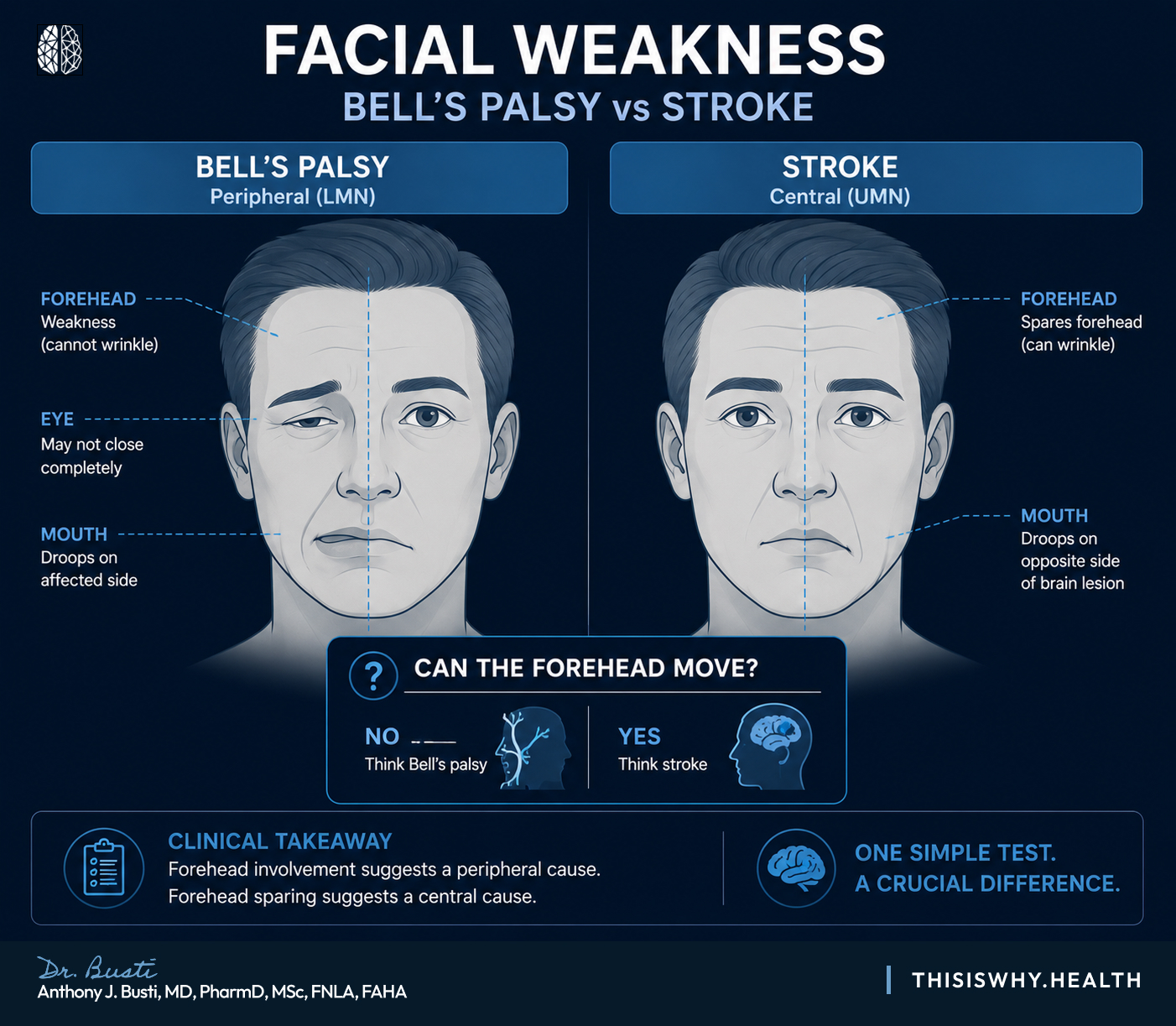
That is why asking the patient to raise their eyebrows matters.
It may seem like a small bedside maneuver, but it can help separate two very different clinical pathways. One may require urgent stroke evaluation and consideration of reperfusion therapy. The other may be managed with steroids, sometimes with antivirals depending on the situation.
Same general complaint. Very different implications.
That is a killer foil.
Sometimes the Medication List Is the Diagnosis
One of the easiest places to miss a clue is the medication list.
The chief complaint may point you in one direction, but the medication list may be telling you something else. A patient presents with confusion, gait instability, slurred speech, or nystagmus. Your mind may go to stroke, intoxication, infection, or metabolic encephalopathy. All of those may be reasonable considerations.
But if the patient is taking phenytoin, lithium, valproic acid, or digoxin, you need to pause.
Phenytoin toxicity can cause nystagmus, ataxia, and gait instability. Lithium toxicity can produce neurologic findings that may mimic other central nervous system problems. Valproic acid can be associated with hyperammonemic encephalopathy. Digoxin toxicity can present with gastrointestinal symptoms, visual changes, arrhythmias, and dangerous electrolyte patterns.
None of that means every neurologic complaint in a patient taking one of these drugs is automatically drug toxicity. That would be anchoring in the other direction.
But it does mean the medication list deserves attention.

A better clinician does not simply ask, “What medications is this patient taking?” A better clinician asks, “Could any of these medications explain what I am seeing?”
That is a different level of thinking.
Board Exams Use Red Flags Because Medicine Uses Red Flags
It is easy to become cynical about board-style questions. People sometimes say, “They’re trying to trick me.”
But most well-written clinical questions are not trying to trick you. They are trying to determine whether you recognize the clue that should change your thinking.
That is why the stem includes details that may seem small. A medication was recently added. The lymph nodes are posterior. The facial weakness includes the forehead. The glucose is lower than expected despite ketoacidosis. The patient is taking an SGLT2 inhibitor. The wound followed a cat bite, dog bite, human bite, or seawater exposure.
Those details are not decorations.They are there because they matter.
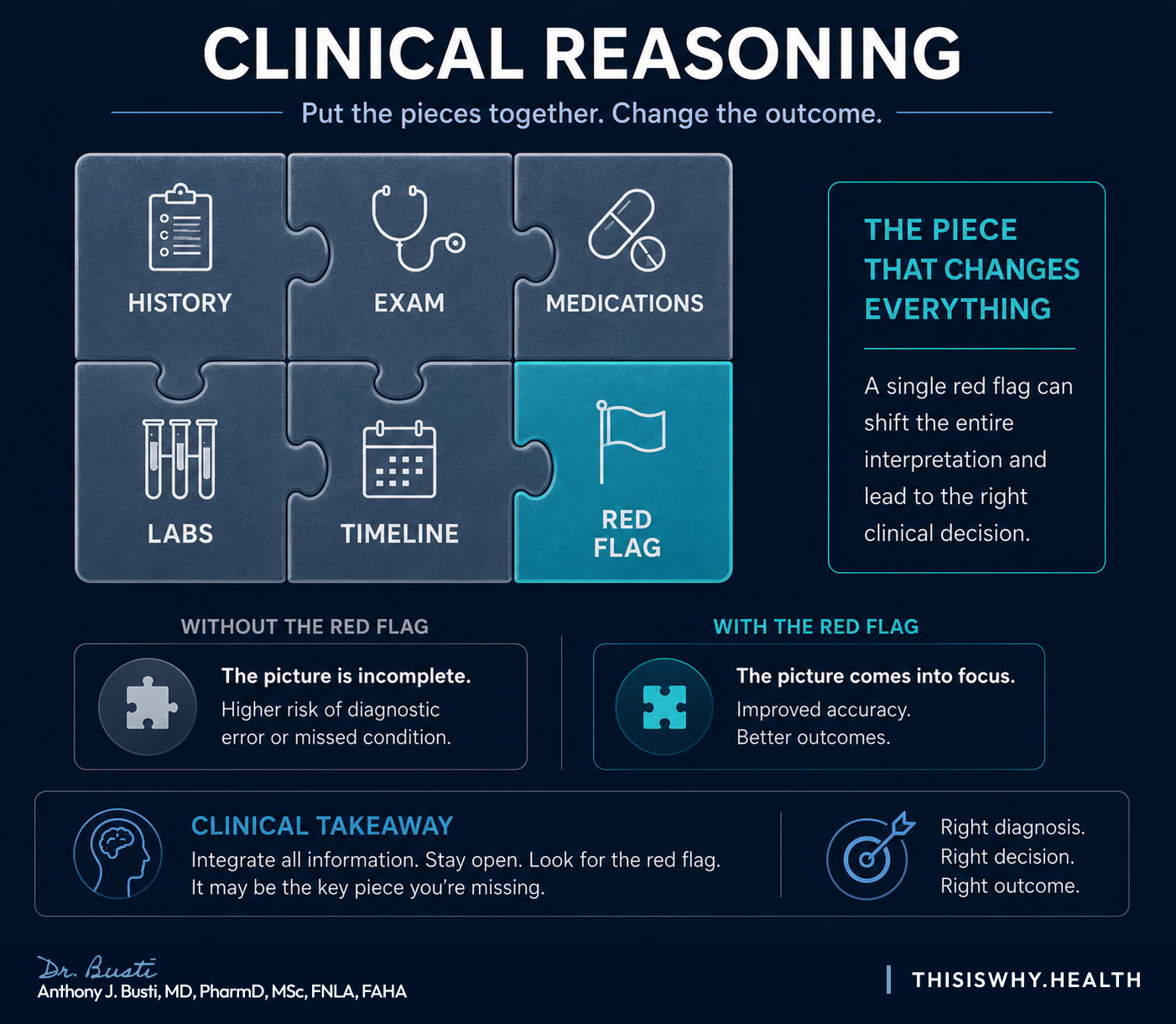
The same is true in practice. Patients do not walk in holding a sign that says, “Here is my diagnosis, and here are four answer choices.” They come in with messy stories, overlapping symptoms, incomplete histories, and competing possibilities.
That is why red flags matter. They help you avoid treating the first pattern you recognize when another pattern explains the case better.
How to Train This Skill
The way to build this skill is not simply to memorize more facts. Facts matter, but memorization alone is not enough. You have to practice asking better questions when you review a case.
Instead of stopping at, “What was the right answer?” ask, “What detail was I supposed to notice?” Ask yourself what diagnosis you were tempted to anchor on. Ask what feature separated the look-alike conditions. Ask whether a medication, lab value, exposure, or timeline should have changed your thinking.
Most importantly, ask what would have happened clinically if you missed the clue.
That is how one case becomes more than one case. It becomes a framework you can use again.
This is also where the “why” becomes so important. When you understand why a clue matters, you are not just preparing for one version of a question. You are preparing for the next patient, the next case, and the next variation of the same clinical principle.
The Bottom Line
Medicine is full of patterns. That is helpful, because pattern recognition allows clinicians to make decisions efficiently.
But the best clinicians do not just recognize patterns. They recognize when the pattern is incomplete, misleading, or dangerous.
A red flag is the detail that tells you to pause. A killer foil is the look-alike condition that reminds you not to anchor too soon. Clinical reasoning is the discipline of asking whether everything in the case actually fits.
That question matters on exams. It matters in training. It matters at the bedside.
Because sometimes the clue you miss is the clue that changes everything.

Anthony J. Busti, MD, PharmD, MSc, FNLA, FAHA