



The Illusion of “Practicing” Evidence-Based Medicine
Most clinicians believe in the concept of evidence-based medicine.
We were taught the five A’s.
We passed the exams.
We reference guidelines.
We use summaries.
And yet—if we’re honest—evidence-based medicine is not consistently practiced the way it was originally envisioned.
Not because clinicians don’t care.
Not because they aren’t intelligent.
But because practicing true EBM is harder than we were led to believe.
And now, in the age of AI, that difficulty matters more than ever.
The Illusion of Practicing EBM
It’s easy to assume we’re “doing EBM” because:
- We follow guidelines
- We check a clinical summary tool
- We remember a landmark trial
- We quote a recommendation
But that’s not the same as understanding the evidence and applying it in its proper context.
Understanding the evidence means knowing:
- What outcome was actually measured
- Whether mortality was all-cause or disease-specific
- Whether the benefit applied to primary or secondary prevention
- Whether the study population resembles your patient
There’s a difference between repeating a recommendation and understanding why that recommendation exists.
And that gap is where problems begin.

Why EBM Sometimes Doesn’t Stick
Research shows that teaching EBM improves knowledge — at least temporarily. But over time, clinicians often drift back to habit, authority, or convenience.
Why?
1. Cognitive Overload
Medicine, pharmacy, and nursing can be overwhelming. From the earliest stages of training, we drink from a fire hydrant of information. By the time we’re practicing independently, most of us are trying to survive the day’s demands.
When you’re drowning, most don’t have the time to appraise primary literature.
You reach for summaries.
There’s nothing inherently wrong with summaries. But if we never learned how to interpret the underlying evidence, we can’t evaluate when the summary overreaches, simplifies, or generalizes beyond the data.
2. Identity Threat
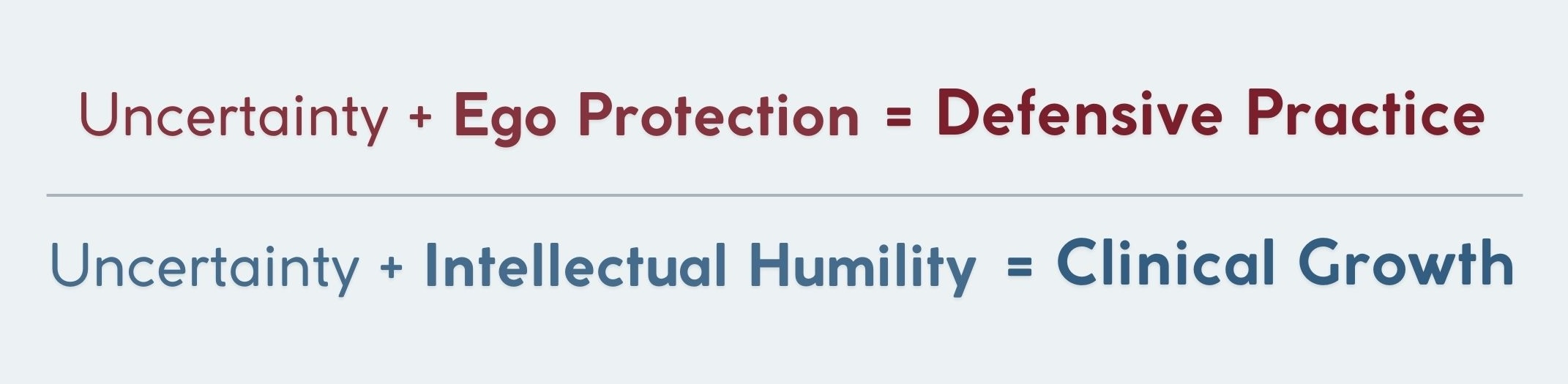
After years of training, admitting “I don’t know” can feel destabilizing. We call this cognitive dissonance (i.e., knowing that we don’t know something that we should probably know or people expect us to know). If we respond wrongly to this, it can lead to frustration, unprofessional behavior, and even underlying feelings of failure after so many years of work.
That is why it’s easier to rely on what we’ve always done.
Easier to quote a guideline.
Easier to defer to consensus.
But true evidence-based medicine applied in real-world clinical practice requires intellectual humility — the willingness to acknowledge what we don’t know so we can fill the gap.
That’s uncomfortable, and discomfort is something most high-achieving professionals try to avoid. However, if we see it as an opportunity to grow, then we promote the goal of “lifelong learning”.
3. System Pressure
Time constraints. Documentation. RVUs. Throughput metrics.
The healthcare system is not built for slow, reflective appraisal of evidence at the bedside.
But here’s the hard truth: system pressure does not eliminate responsibility. It increases it.
The AI Inflection Point
We now have tools that can synthesize data in seconds. Clinical decision-support systems are growing more sophisticated. AI can summarize entire bodies of available literature instantly.
But here’s the disruptive reality:
If you don’t understand the evidence, you can’t recognize when the machine is potentially wrong or outside of the proper context.
Don’t get me wrong — I am not against AI. It is a tool, like anything else: a tool I control, not one that controls me.
Furthermore, AI has limitations in the information it can access and synthesize. This can lead to inaccurate perspectives because not all AI systems — or service tiers — have access to the full body of available information.
Therefore, AI can aggregate information.
But it cannot totally replace clinical judgment.
And judgment requires understanding:
- Study design
- Bias
- Effect size
- Proper interpretation
- Applicability
- Context
If we outsource our thinking without understanding the foundation, we move from evidence-based practitioners to passive recipients of algorithmic recommendations.
That is not progress. It creates dependency and could undermine the goal of lifelong learning if misused or relied on at this level.
What Practicing EBM Actually Looks Like
t’s not quoting journal names or memorizing p-values.
It’s asking better questions:
- What outcome did this trial actually measure?
- Is this benefit clinically meaningful or just statistically significant?
- Was this population similar to the patients I see?
- What are the tradeoffs?
It’s integrating:
- Core knowledge
- The best available evidence
- Clinical expertise
- Patient-specific factors
That integration is what transforms a practitioner into an expert.
And yes — it’s harder.
Why the Hard Work Is Worth It
We spend more on healthcare than almost any comparable nation. We have extraordinary technology. Unlimited access to information. Advanced therapeutics.
And yet outcomes often lag.
Technology alone doesn’t improve care.
Access to information alone doesn’t improve care.
Clinicians who can interpret and apply evidence well improve care.
When we understand the “why” behind our decisions:
- We communicate more clearly with patients.
- We avoid overgeneralization.
- We reduce unnecessary interventions.
- We practice with confidence instead of habit.
Evidence-based medicine is not about becoming academic.
It’s about becoming precise.
It’s about aligning what we do with what actually works — and knowing when it doesn’t.
Evidence-based medicine (EBM) is hard.
But difficulty is not a sign that something is impractical.
Sometimes it’s a sign that it matters.
The goal isn’t perfection.
The goal is progression.
Because when you understand the evidence, you’re not just practicing medicine, pharmacy, or nursing.
You’re strengthening it.
For those who want to strengthen their ability to interpret and apply evidence — not just reference it — our Evidence-Based Medicine series walks step by step through study design, bias, effect size, and clinical applicability. The goal isn’t memorization. It’s building the judgment required to recognize when recommendations fit… and when they don’t.

Anthony J. Busti, MD, PharmD, MSc, FNLA, FAHA