




Why Practicing Difficult Questions Is the Most Overlooked Strategy in Board Exam Success
You can read every guideline.
You can watch every lecture.
You can highlight every page.
And still fail your board exam.
That’s not pessimism—it’s reality across medicine, pharmacy, nursing, and advanced practice training.
Because board exams are designed to do something very specific: they don’t test what you know—they test how you use what you know. And that distinction is where most candidates fall short.
The Hard Truth About Board Exams
No matter the discipline—USMLE, PANCE, NP certification, NAPLEX, or specialty boards—the pattern is the same. Highly capable, well-trained clinicians sit for these exams, and a meaningful percentage don’t pass on the first attempt.
That’s not because they didn’t study. It’s because they prepared in a way that didn’t match what the exam actually demands.
These exams are not built to reward memorization alone. They are multiple-choice, case-based, timed assessments designed to evaluate decision-making. In other words, they are testing how you think under pressure—not just what you can recall in a low-stakes environment.
The Misconception That Holds People Back
Most people prepare the way they always have: they watch lectures, read textbooks, and review notes. That approach builds familiarity, and familiarity feels like progress.
But familiarity is not the same as readiness.
Board exams require knowledge transfer—the ability to take foundational concepts and apply them in new, unfamiliar scenarios. You’re rarely asked to simply recall a fact. Instead, you’re asked to interpret a clinical situation, weigh competing options, and choose the best answer based on subtle details.
If your preparation doesn’t include practicing that process, you’re preparing for a different test than the one you’re about to take.

Why Difficult Questions Are the Shortcut (Not the Obstacle)
Most learners avoid difficult questions because they’re uncomfortable. That instinct makes sense—but it’s also exactly what holds people back.
Challenging questions force you into the gap between what you think you know and what you can actually apply. They expose blind spots that passive review never reveals. It’s one thing to recognize the correct answer when you see it; it’s another to arrive at it on your own, under pressure, with competing options in front of you.
They also train you to think the way the exam expects you to think. Over time, you begin to recognize patterns—how questions are structured, how distractors are designed, and how small details in a case can completely change the correct answer.
And perhaps most importantly, they build decision-making speed. On most board exams, you have about a minute per question. There’s no time to debate endlessly or second-guess every possibility. You have to recognize the pattern, interpret the information, and make a decision—quickly and confidently.
That only comes from practice.
The “Why” Is Your Competitive Advantage
If there is one shift that changes everything, it’s this: stop memorizing answers and start understanding why they are correct.
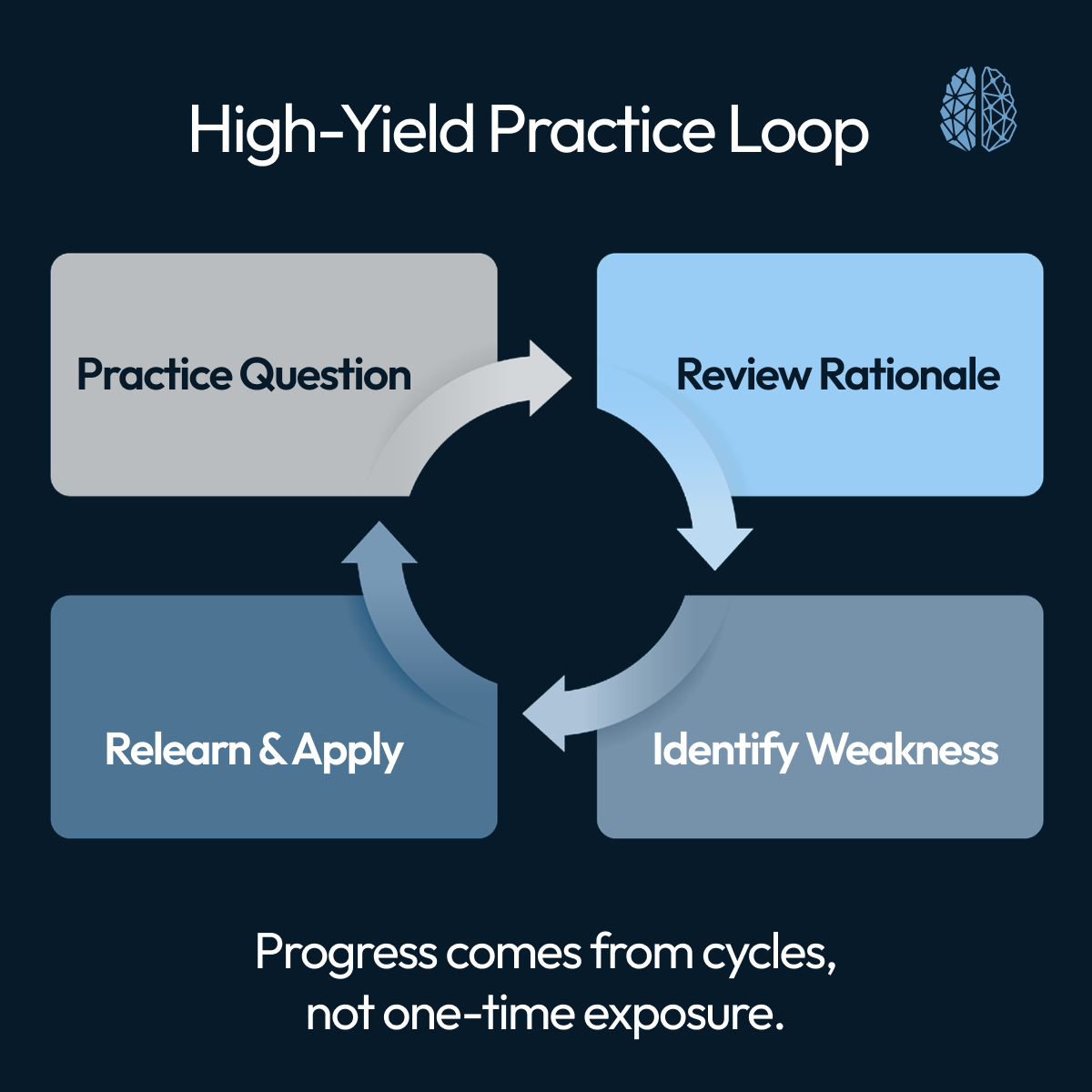
When you review a question, don’t stop at whether you got it right or wrong. Ask yourself why the correct answer is the best choice—and just as importantly, why the other options are not.
That process forces you to connect concepts instead of isolating facts. It turns a single question into a framework you can apply again and again.
Because when you truly understand the “why,” you’re no longer preparing for one version of a question. You’re preparing for every variation of that concept the exam might present.

Train for the Test You’re Actually Taking
If you were training for a marathon, you wouldn’t just read about running—you would run. The same principle applies here.
Board exams are long, mentally demanding, and highly structured. They require endurance, focus, and pattern recognition over extended periods of time. Yet many people prepare in ways that never simulate that experience.
To perform well, your preparation has to reflect the reality of the test. That means consistently working through questions, practicing under timed conditions, and building the stamina to stay sharp from the first question to the last.
Confidence doesn’t come from hoping you’re ready. It comes from repeatedly proving to yourself that you can perform.
This Is Bigger Than the Exam
Passing matters—but the deeper goal is competence.
When you train yourself to apply knowledge instead of simply recalling it, you don’t just become a better test-taker. You become a better clinician. You think more clearly, make better decisions, and approach complex situations with greater confidence.
That’s ultimately what these exams are trying to measure.
If you take one thing from this, let it be this:
Stop studying to recognize answers.
Start training to explain them.
Focus on the “why.” Practice applying it consistently. That’s how you walk into any board exam—regardless of discipline—ready for what it throws at you.
Want a structured way to train this skill?
High-Yield Med Reviews, created by Dr. Busti, is built around this exact philosophy. It’s designed to move you beyond memorization and into true application—through question-based learning, case-driven reviews, and performance tracking that shows you exactly where to focus.
Because the goal isn’t just to pass.
It’s to understand the material in a way that makes passing the natural outcome.
And if you're part of This Is Why, you have access to discounts for High-Yield products. (Found in Your Plan and Benefits section)

Anthony J. Busti, MD, PharmD, MSc, FNLA, FAHA