




Why Staying Current Isn't the Same as Studying for Boards
Many healthcare professionals assume that if they're actively practicing, attending conferences, and completing continuing education (CE) activities, they should naturally be prepared for their board examinations.
After all, both activities involve learning medicine.
So why do experienced clinicians sometimes struggle with board exams?
The answer lies in understanding that clinical practice and board examinations serve different purposes. While there is certainly overlap between the two, they are not designed to assess the same type of knowledge.

Clinical Practice Lives in the Present
Healthcare is constantly evolving.
Every year brings new clinical trials, updated guidelines, emerging therapies, and changing standards of care. Continuing education programs help clinicians stay informed about these developments so they can make better decisions for their patients today.
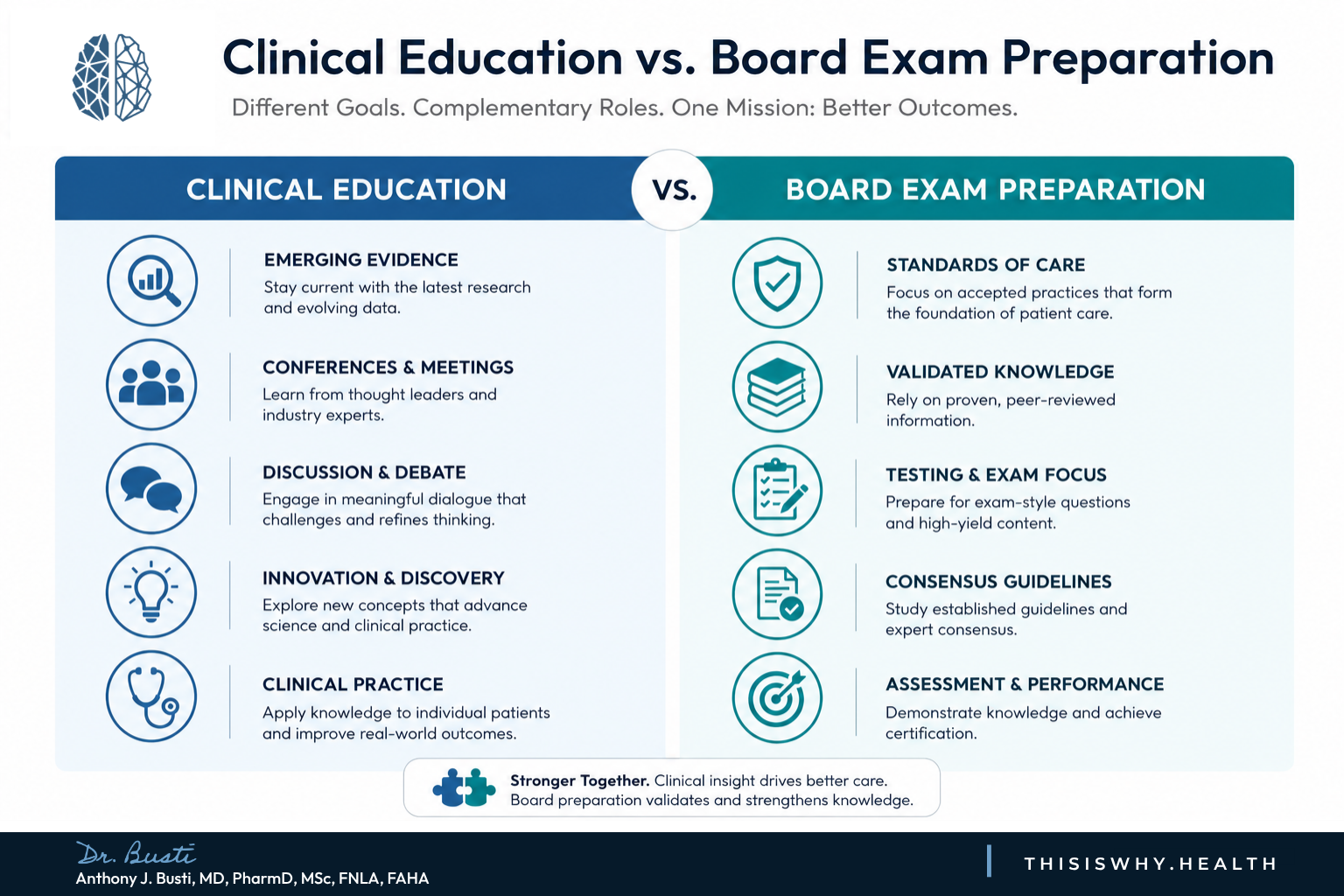
In many cases, educational conferences focus on areas where evidence is still emerging. Experts may discuss controversial topics, differing interpretations of data, or evolving treatment strategies. These discussions are valuable because they encourage critical thinking and help clinicians adapt to a changing healthcare landscape.
But that isn't what most board examinations are designed to assess.
Board Exams Measure Established Knowledge
Board examinations must be fair, standardized, and defensible.
Before a concept can appear on an examination, it typically undergoes a lengthy process involving content development, expert review, psychometric analysis, and validation. The goal is to ensure that every question has one best answer supported by broadly accepted evidence.
This process creates an unavoidable delay between the newest medical advances and what eventually appears on an examination.
In other words, the most exciting presentation from last month's national conference may be highly relevant to patient care—but still be years away from becoming board-exam content.
Board exams generally focus on concepts that are:
- Well established
- Widely accepted
- Supported by strong evidence
- Consistent across practice settings
When preparing for boards, mastering foundational principles often produces greater returns than chasing the latest clinical controversy.
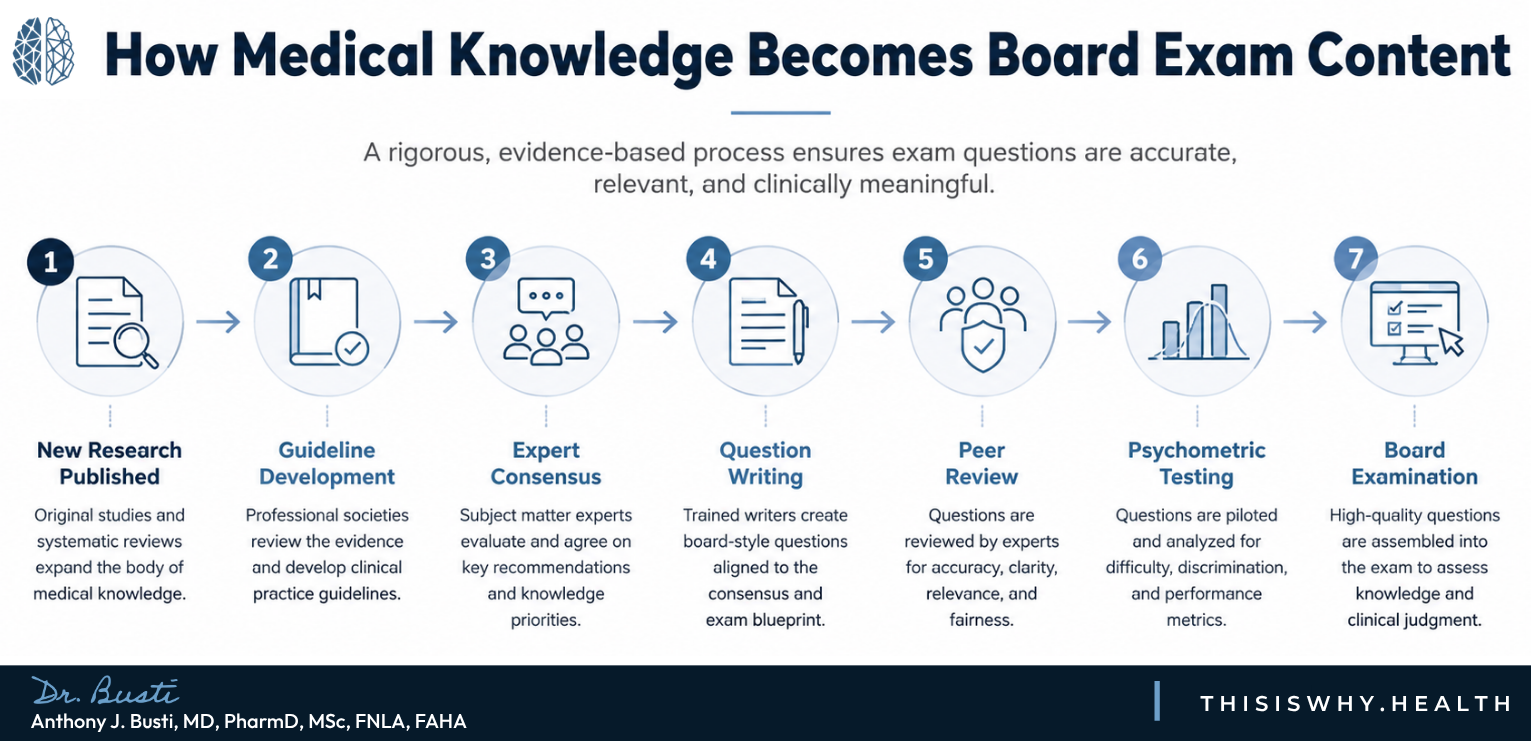
The Challenge of Testable Knowledge
One of the biggest differences between clinical education and board preparation is the requirement for certainty.
In practice, two experienced clinicians may reasonably approach the same patient differently. Nuance is often appropriate and expected.
Board examinations, however, require a single defensible answer.
Questions that depend heavily on individual practice style, institutional preferences, or unresolved controversies are difficult to test fairly. As a result, examination content tends to focus on areas where professional consensus exists.
This is why being an excellent clinician does not automatically translate into being an excellent test taker.
Clinical expertise often embraces nuance.
Board examinations often reward recognition of established principles.
Geography Matters Less Than You Think
Practice patterns can vary across institutions, regions, and healthcare systems.
A treatment approach that is common in one setting may be less common in another. For board examinations, however, questions must apply broadly to candidates regardless of where they practice.
The concepts most likely to appear on an exam are those that represent national standards rather than local preferences.
If the "correct" answer depends on where someone practices, it is generally less suitable for standardized testing.
How to Evaluate Educational Content for Board Preparation
When attending a conference, completing CE activities, or reviewing clinical literature, ask yourself three questions:
1. Is this an established standard of care?
The more established and widely accepted the concept, the more likely it is to be relevant for board examinations.
2. Would this have been considered true a year ago?
Because examination content development takes time, concepts that have remained stable over time are often more testable than brand-new developments.
3. Is this applicable regardless of where I practice?
Nationally accepted standards are more likely to appear on examinations than institution-specific practices or regional variations.
The Bottom Line
Continuing education and board preparation are both valuable, but they serve different goals.
Continuing education helps clinicians stay current and improve patient care. Board preparation focuses on identifying and applying established knowledge that can be assessed consistently across all candidates.
The most effective board review programs bridge this gap by emphasizing knowledge transfer—the ability to apply foundational concepts across multiple clinical scenarios.
Success on board examinations rarely comes from memorizing the newest information. More often, it comes from understanding the enduring principles that continue to guide clinical decision-making long after the latest headlines have faded.
Knowing what is testable is important, but passing a board exam requires more than exposure to information—it requires the ability to retrieve and apply that information under exam conditions. This is where many learners make a critical mistake. They spend hours reviewing notes, articles, and lectures but very little time practicing knowledge transfer. Well-designed practice questions force you to connect concepts, identify patterns, and apply foundational principles to new scenarios—the exact skill board examinations are designed to assess. In our article, How to Pass Any Board Exam: Why Practice Questions Matter More Than Studying, we discuss why active retrieval is one of the most powerful tools available for board exam success.

Anthony J. Busti, MD, PharmD, MSc, FNLA, FAHA