






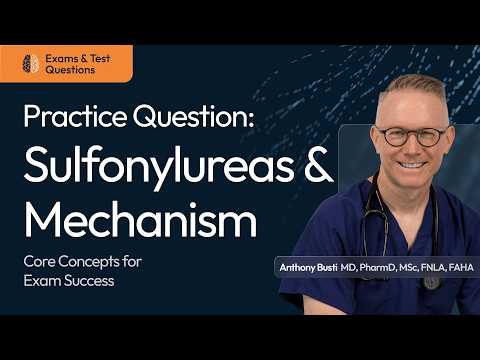
To view this video, please enable marketing cookies from Cookie Preferences in the footer.

Why sulfonylureas cause hypoglycemia becomes much easier to understand once you know how pancreatic beta cells regulate insulin secretion. In this episode of This Is Why with Dr. Busti, we walk through a board-style pharmacology question that connects ATP-sensitive potassium channels, membrane depolarization, calcium influx, and insulin release into one clinically useful framework.
Instead of memorizing isolated diabetes medication facts, this episode explains the physiology behind insulin secretagogues and why missed meals can become dangerous in patients taking sulfonylureas or meglitinides. Dr. Busti breaks down the mechanism step-by-step so you can reason through pharmacology questions, recognize common board-style distractors, and apply the concepts clinically.
This Is Why stronger pharmacology understanding improves both exam performance and patient care.
Topics Covered:
- Hypoglycemia caused by sulfonylureas
- Meglitinide mechanism of action
- ATP-sensitive potassium channels
- Pancreatic beta-cell physiology
- Insulin secretion pathway
- Membrane depolarization in beta cells
- Calcium influx and insulin release
- Board-style pharmacology reasoning
- High-yield endocrinology pharmacology
- Missed meal hypoglycemia risk
- Toxicology and recurrent hypoglycemia
- Octreotide in sulfonylurea toxicity
- Clinical reasoning for diabetes medications
- Mechanism-based test-taking strategies
Chapter Table of Contents
00:00 Intro – Hypoglycemia After Skipping Dinner: What Boards Are Really Testing
00:45 Why Mechanisms Matter More Than Memorization in Pharmacology
01:27 Board-Style Diabetes Pharmacology Question Explained
02:25 How Pancreatic Beta Cells Control Insulin Release
03:04 Beta Cell Physiology: Converting Glucose Into Insulin Secretion
04:10 What Is an Insulin Secretagogue? Sulfonylureas & Meglitinides
05:24 ATP-Sensitive Potassium Channels and Insulin Release Mechanism
06:58 Why Sulfonylureas Cause Hypoglycemia When Patients Skip Meals
07:47 Breaking Down the Wrong Answer Choices on Board Exams
09:28 Clinical Risks of Sulfonylureas in Older Adults and Renal Disease
10:32 Sulfonylurea-Induced Hypoglycemia and Octreotide Treatment
11:21 High-Yield Exam Strategy: Think in Mechanisms, Not Buzzwords
If this helped you, please like, subscribe to our YouTube Channel, and share it with a classmate or colleague. That will help this new channel continue producing free, high-yield medical education content.
Don’t forget to turn on notifications on YouTube so you don’t miss upcoming lectures in pharmacology, medical rounds, and more!
#Sulfonylureas #Hypoglycemia #InsulinSecretion #BetaCellPhysiology #DrBust
Speaker:
Anthony Busti, MD, PharmD, MSc, FAHA, FNLA, is a licensed healthcare professional and medical educator with over 30 years of experience in clinical practice and academic teaching. He has trained and practiced as a nurse, pharmacist, and physician, bringing a uniquely comprehensive perspective to patient care and medical education.
Dr. Busti is dedicated to advancing evidence-based medicine and helping clinicians understand the underlying “why” behind clinical decisions to improve patient outcomes.
About This Channel:
This content is created by Anthony Busti, MD, PharmD, MSc, FAHA, FNLA, a board-certified physician with training at Johns Hopkins School of Medicine and University of Oxford and a medical educator for healthcare professionals and students. All material is based on current medical literature and evidence-based guidelines that align with principles of evidence-based medicine (EBM) and Evidence-Based Healthcare (EBHC).
Disclaimer:
This content is for educational purposes only and is not medical advice. It does not replace individualized evaluation, diagnosis, or treatment. Always seek the advice of a qualified health provider with questions about a medical condition and never delay care because of educational content.
More than just access—it’s where understanding deepens.
Create a free account or log in to gain access to this content!
Dive Deeper
Bonus Video (ad free)

To view this video, please enable marketing cookies.
Downloads
Dive Deeper
Bonus Video
Downloads
Related Topics


.jpg)
.jpg)


