







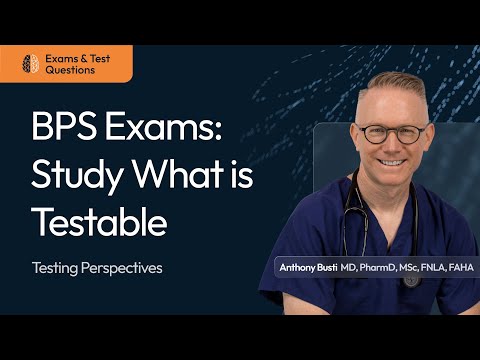
To view this video, please enable marketing cookies from Cookie Preferences in the footer.

In this episode of This Is Why, Dr. Busti breaks down how to focus your BPS exam prep on what truly matters — what is testable. Passing your specialty exam isn’t about memorizing more or guessing what you think should be on the test. It’s about mastering the high-yield, validated concepts that BPS exam committees can legally and reliably score.
Drawing on 25+ years in pharmacy education and direct experience developing BPS exam review programs, Dr. Busti explains how these exams are built, what makes a topic testable, and why so many candidates waste valuable study time on content that will never appear on the exam.
You’ll learn how the BPS job analysis process defines scope, what the blueprints really mean, and how to build a purposeful study strategy that focuses on understanding the why behind every question — not just memorizing the what.
TOC
00:00 – Welcome to This Is Why with Dr. Busti
02:01 – Why most pharmacists fail BPS Pharmacy exams
03:57 – How BPS pharmacy specialty exams are developed and validated
04:48 – Understanding job analysis and national scope
05:53 – What “testable” really means
06:22 – The truth about new content and unscored questions
09:20 – Why blueprints feel vague (and how to use them)
12:32 – How to study smarter: focus on core, testable concepts
13:57 – Closing thoughts: mastering the “why” to pass on your first try
Speaker:
Anthony Busti, MD, PharmD, MSc, FAHA, FNLA, is a licensed healthcare professional and medical educator with over 30 years of experience in clinical practice and academic teaching. He has trained and practiced as a nurse, pharmacist, and physician, bringing a uniquely comprehensive perspective to patient care and medical education.
Dr. Busti is dedicated to advancing evidence-based medicine and helping clinicians understand the underlying “why” behind clinical decisions to improve patient outcomes.
About This Channel:
This content is created by Anthony Busti, MD, PharmD, MSc, FAHA, FNLA, a board-certified physician with training at Johns Hopkins School of Medicine and University of Oxford and a medical educator for healthcare professionals and students. All material is based on current medical literature and evidence-based guidelines that align with principles of evidence-based medicine (EBM) and Evidence-Based Healthcare (EBHC).
Disclaimer:
This content is for educational purposes only and is not medical advice. It does not replace individualized evaluation, diagnosis, or treatment. Always seek the advice of a qualified health provider with questions about a medical condition and never delay care because of educational content.
More than just access—it’s where understanding deepens.
Create a free account or log in to gain access to this content!
Dive Deeper
Bonus Video (ad free)

To view this video, please enable marketing cookies.
Downloads
Dive Deeper
Bonus Video
Downloads
Related Topics



.jpg)
.jpg)


