







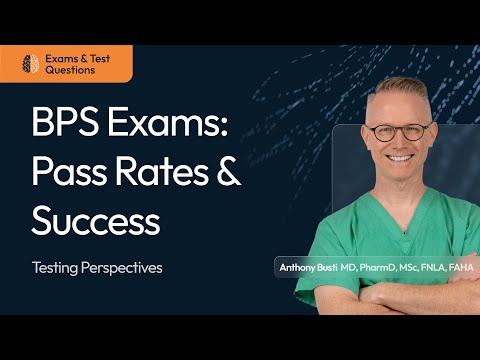
To view this video, please enable marketing cookies from Cookie Preferences in the footer.

In this episode of This Is Why, Dr. Busti shares key insights on how to strategically prepare for — and pass your BPS specialty exam on the first try. Drawing on years of experience teaching and mentoring pharmacists through board preparation, he highlights what separates those who pass from those who don’t — and it’s not luck.
Learn how to interpret BPS pass rate trends, identify proven predictors of success, and apply evidence-based strategies to your study plan. Whether you’re pursuing BCPS, BCCCP, BCACP, or another BPS credential, this session will help you refocus your preparation, optimize your approach, and maximize your chances of success.
TOC
00:00 – Welcome to This Is Why with Dr. Busti
00:13 – The strategy behind passing, not luck
00:48 – Key predictors of success and failure
01:09 – BPS pass rate trends: what the data shows
02:28 – Why some exams have lower pass rates
03:43 – Residency training and performance advantage
04:05 – Building an evidence-based study strategy
05:44 – How non-residency pharmacists can still succeed
13:57 – Final tips and encouragement for first-time test takers
Speaker:
Anthony Busti, MD, PharmD, MSc, FAHA, FNLA, is a licensed healthcare professional and medical educator with over 30 years of experience in clinical practice and academic teaching. He has trained and practiced as a nurse, pharmacist, and physician, bringing a uniquely comprehensive perspective to patient care and medical education.
Dr. Busti is dedicated to advancing evidence-based medicine and helping clinicians understand the underlying “why” behind clinical decisions to improve patient outcomes.
About This Channel:
This content is created by Anthony Busti, MD, PharmD, MSc, FAHA, FNLA, a board-certified physician with training at Johns Hopkins School of Medicine and University of Oxford and a medical educator for healthcare professionals and students. All material is based on current medical literature and evidence-based guidelines that align with principles of evidence-based medicine (EBM) and Evidence-Based Healthcare (EBHC).
Disclaimer:
This content is for educational purposes only and is not medical advice. It does not replace individualized evaluation, diagnosis, or treatment. Always seek the advice of a qualified health provider with questions about a medical condition and never delay care because of educational content.
More than just access—it’s where understanding deepens.
Create a free account or log in to gain access to this content!
Dive Deeper
Bonus Video (ad free)

To view this video, please enable marketing cookies.
Downloads
Dive Deeper
Bonus Video
Downloads
Related Topics




.jpg)



.jpg)


