



To view this video, please enable marketing cookies from Cookie Preferences in the footer.

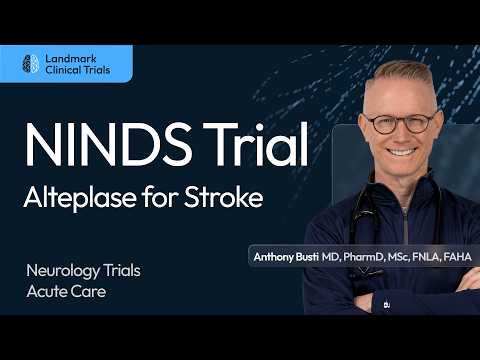
Stroke thrombolysis changed emergency neurology forever—but understanding why the NINDS trial mattered is what transforms memorization into clinical decision-making. In this episode of This Is Why with Dr. Busti, we break down the landmark NINDS rt-PA trial that established alteplase as a treatment for acute ischemic stroke and explore the real-world balance between functional recovery and intracerebral hemorrhage risk.
Dr. Busti explains how to interpret the trial beyond headlines by walking through the study design, inclusion criteria, outcomes, NNT and NNH calculations, odds ratios, bleeding risk, and the evolution of thrombolytic therapy from alteplase to tenecteplase. This episode also contextualizes modern AHA/ASA recommendations and what clinicians should actually say during bedside risk-benefit discussions with patients and families.
This Is Why medical education focuses on understanding the “why” behind clinical decisions so healthcare professionals can apply evidence with confidence and clarity.
Topics Covered:
- NINDS rt-PA trial explained
- Alteplase for acute ischemic stroke
- Stroke thrombolysis risks and benefits
- Functional recovery vs hemorrhage risk
- NNT and NNH interpretation
- Odds ratio vs absolute risk
- Tenecteplase vs alteplase
- Modern stroke thrombolysis guidelines
- Shared decision-making in stroke care
- Why early reperfusion matters
The goal = make medical education easy and clinically relevant.
Watch other videos referenced in this episode!
P-Value: https://youtu.be/ibl85Flpm94
Alpha Value Explained: https://youtu.be/Fmu4HwaGrtU
Power Analysis - Type II Error Risk: https://youtu.be/zn9q9E1IOoc
Chapter Table of Contents
00:00 - Introduction
01:46 - NINDS Trial (1995)
04:40 - Trial Design, Inclusion & Exclusion Criteria
06:38 - Part 1: The Negative 24-Hour Endpoint Explained
11:28 - Part 2: Functional Outcomes That Changed Practice
13:45 - NNT, NNH & Explaining Risk to Patients
19:18 - One-Year Outcomes & Interpreting Odds Ratios Correctly
22:09 - Later Evidence, Meta-Analyses & Expanded Treatment Windows
25:30 - Tenecteplase vs Alteplase & Modern Stroke Practice
28:17 - Conclusion
If this helped you, please like, subscribe, and share it with a classmate or colleague. That will help this new channel continue producing free, high-yield medical education content.
Don’t forget to turn on notifications so you don’t miss upcoming lectures in pharmacology, medical rounds, and more!
#AcuteIschemicStroke #NINDSTrial #StrokeThrombolysis #Alteplase #Tenecteplase #DrBusti
Speaker:
Anthony Busti, MD, PharmD, MSc, FAHA, FNLA, is a licensed healthcare professional and medical educator with over 30 years of experience in clinical practice and academic teaching. He has trained and practiced as a nurse, pharmacist, and physician, bringing a uniquely comprehensive perspective to patient care and medical education.
Dr. Busti is dedicated to advancing evidence-based medicine and helping clinicians understand the underlying “why” behind clinical decisions to improve patient outcomes.
About This Channel:
This content is created by Anthony Busti, MD, PharmD, MSc, FAHA, FNLA, a board-certified physician with training at Johns Hopkins School of Medicine and University of Oxford and a medical educator for healthcare professionals and students. All material is based on current medical literature and evidence-based guidelines that align with principles of evidence-based medicine (EBM) and Evidence-Based Healthcare (EBHC).
Disclaimer:
This content is for educational purposes only and is not medical advice. It does not replace individualized evaluation, diagnosis, or treatment. Always seek the advice of a qualified health provider with questions about a medical condition and never delay care because of educational content.
More than just access—it’s where understanding deepens.
Create a free account or log in to gain access to this content!